
Who will fund a UK degree from your country?
148 ways to pay, in 31 of 37 countries — and where each one comes from.
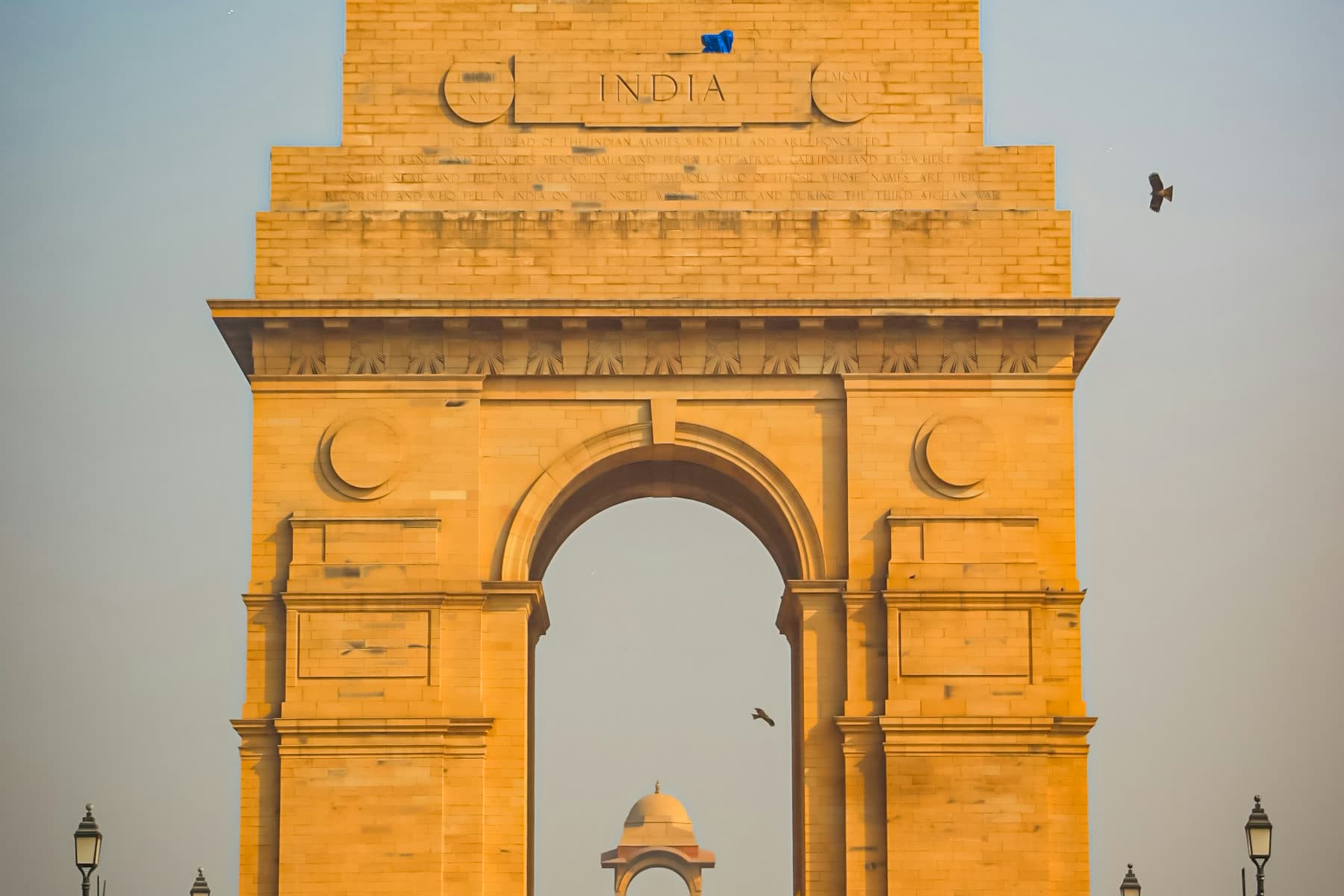
On the cover: India Gate, New Delhi. India has more ways to fund a UK degree than any other country we researched — 21. Photo: Swipe / Unsplash.
The Bottom Line
A UK undergraduate degree costs an international family a median of £118,308. Very few families pay that from savings alone, so the question that matters most is where the rest can come from — and the answer depends almost entirely on where you live.
We checked 942 possible sources of money across 37 countries: banks and other lenders, national and state governments, and the companies, foundations and community bodies that sponsor students abroad. Every one was read on the provider's own pages. 148 can fund a complete UK undergraduate degree from the start, in 31 of the 37 countries. In six countries we found nothing at all.
This guide is the map. The country table in Exhibit 2 shows, for every country we researched, how many routes exist and what kind they are.
What you absolutely need to know:
- 31 of 37 countries have at least one way to fund a UK degree — 148 routes in all
- Where the money comes from depends on where you live
- The routes are concentrated: six countries hold more than half, and eleven have exactly one
- Most routes come with conditions — about where you live, who you are, or what you do afterwards
- Six countries have no route we could find
- A quarter of the sources we checked couldn't answer the question on their own pages
1. 31 of 37 countries have at least one way to fund a UK degree — 148 routes in all
We set one test for every source: does the provider's own material show it can fund a full undergraduate degree at a UK university from the start — not an exchange term, not a master's, not a top-up for a student already abroad? 148 sources pass.
They come from three very different places.
| Source | Routes |
|---|---|
| Banks and other lenders | 83 |
| Sponsors and foundations | 32 |
| State and provincial governments | 22 |
| National governments | 11 |
148 routes across 31 countries. Source: Telariq data.
Banks and other lenders are the largest group: 68 banks and specialist lenders, and 15 non-bank lenders such as finance companies, credit unions and cooperatives. Sponsors and foundations — companies, family foundations and community bodies — account for 32. Governments account for 33: eleven national schemes — including government scholarships in Saudi Arabia, Qatar, Kuwait, Hong Kong and Japan — and 22 run by a state, province or city.
What this means for you: if you have only asked your bank and your national government, you have looked in two of the places money comes from, and often not the most important one.
2. Where the money comes from depends on where you live
| Country | Banks and other lenders | Governments, national and state | Sponsors and foundations | Total |
|---|---|---|---|---|
| India | 19 | 2 | 0 | 21 |
| Canada | 4 | 12 | 0 | 16 |
| Malaysia | 5 | 4 | 5 | 14 |
| Nepal | 12 | 0 | 0 | 12 |
| Japan | 2 | 4 | 4 | 10 |
| Sri Lanka | 10 | 0 | 0 | 10 |
| Hong Kong | 3 | 2 | 4 | 9 |
| Singapore | 3 | 0 | 4 | 7 |
| United States | 4 | 3 | 0 | 7 |
| China | 6 | 0 | 0 | 6 |
| Qatar | 0 | 1 | 3 | 4 |
| Nigeria | 3 | 0 | 0 | 3 |
| Saudi Arabia | 0 | 1 | 2 | 3 |
| Thailand | 1 | 0 | 2 | 3 |
| Bahrain | 0 | 0 | 2 | 2 |
| Bangladesh | 2 | 0 | 0 | 2 |
| Germany | 1 | 1 | 0 | 2 |
| Indonesia | 2 | 0 | 0 | 2 |
| Kuwait | 0 | 1 | 1 | 2 |
| United Arab Emirates | 0 | 1 | 1 | 2 |
| Australia | 1 | 0 | 0 | 1 |
| Brazil | 0 | 0 | 1 | 1 |
| Colombia | 1 | 0 | 0 | 1 |
| Egypt | 1 | 0 | 0 | 1 |
| Ireland | 0 | 1 | 0 | 1 |
| Mexico | 1 | 0 | 0 | 1 |
| New Zealand | 0 | 0 | 1 | 1 |
| Oman | 0 | 0 | 1 | 1 |
| South Korea | 0 | 0 | 1 | 1 |
| Taiwan | 1 | 0 | 0 | 1 |
| Vietnam | 1 | 0 | 0 | 1 |
| France | 0 | 0 | 0 | 0 |
| Ghana | 0 | 0 | 0 | 0 |
| Kenya | 0 | 0 | 0 | 0 |
| Pakistan | 0 | 0 | 0 | 0 |
| Philippines | 0 | 0 | 0 | 0 |
| South Africa | 0 | 0 | 0 | 0 |
Counts only; individual lenders are not named. Source: Telariq data.
The pattern is regional, and it is strong.
In South Asia, the money comes from lenders. India has 19 — sixteen banks and three non-bank lenders — plus two state loan schemes in Gujarat. Nepal has 12 and Sri Lanka 10, all lenders.
In Canada, it comes from government. Alongside the federal student loan program, all ten provinces and Yukon run their own student aid, and each can fund study at a UK university designated for its residents.
In the Gulf and much of East Asia, it comes from sponsors. No bank in any of the six Gulf states offers an education loan that covers a UK degree; the routes are government and company scholarships — the national scholarship schemes of Saudi Arabia, Qatar and Kuwait, and QatarEnergy, Qatar Airways, QAPCO, Aramco, the Kuwait Petroleum Corporation and Bapco Energies. In Japan the largest sums come from foundations: the Yanai Tadashi Foundation pays up to £70,000 a year. Singapore's routes are led by Temasek and Singapore Airlines, Hong Kong's by the Swire and Li Ka Shing foundations.
Malaysia has all three: five banks, company and central-bank scholarships from PETRONAS, Khazanah and Bank Negara Malaysia, and state foundations in Johor, Sabah and Sarawak.
What this means for you: look first where your country's money actually comes from. A family in Mumbai should start with lenders; a family in Doha with employers; a family in Toronto with the provincial student aid office.
3. The routes are concentrated: six countries hold more than half, and eleven have exactly one
India, Canada, Malaysia, Nepal, Japan and Sri Lanka hold 83 of the 148 routes. At the other end, eleven countries have exactly one: Australia, Brazil, Colombia, Egypt, Ireland, Mexico, New Zealand, Oman, South Korea, Taiwan and Vietnam.
One route is not a choice. If that single route is a competitive scholarship, or a scheme only for one community or one city, most families in that country effectively have none.
What this means for you: the number in Exhibit 2 tells you how much choice you have. Where it is one or two, read each route's conditions before you count on it.
4. Most routes come with conditions — about where you live, who you are, or what you do afterwards
A route that qualifies exists. It does not mean a given family can use it.
Where you live. Every state and provincial scheme is for its own residents: Ontario's for Ontario, New Jersey's for New Jersey, Gujarat's for students from Gujarat — and only from certain communities, with an income limit for some.
Who you are. Some routes serve one community: MENDAKI in Singapore for the Malay and Muslim community, Ngāi Tahu's grant in New Zealand for its members. Some foundations set income limits or age limits; Yanai's, for instance, requires Japanese nationality and a household income up to ¥27 million.
What you do afterwards. Eleven of the newer routes are bonded sponsorships, which fund a degree in return for years of work. Qatar Airways asks for five years after graduation; Singapore Airlines a six-year bond; Temasek a four-year bond; Bank Negara Malaysia two years of service for every year of study.
And how much it covers. Many routes don't say. Of the 69 routes we found beyond banks and national governments, 36 don't state whether they cover tuition, living costs or both. Ireland's national grant covers living costs only; the UAE's Al Qasimi Foundation pays a monthly living stipend.
What this means for you: before relying on any route, check three things — whether you are eligible, what it pays for, and what it asks in return.
5. Six countries have no route we could find
France, Ghana, Kenya, Pakistan, the Philippines and South Africa returned no qualifying route in any of the three categories, across banks, governments and sponsors alike.
In most of them the reason is structural. National student loans in Kenya, Ghana, South Africa and the Philippines are tied to institutions at home. France's state-guaranteed loan requires a French institution. In Pakistan, none of the 16 banks we checked confirms it can fund a degree abroad, and the community lender we could read funds study inside Pakistan.
This is not proof that no money exists: our search was bounded, and some providers' pages could not be read. But it does mean the answer is not published where a family can find it.
What this means for you: families in these six countries should plan around savings, UK university scholarships, and direct enquiries to lenders — in writing.
6. A quarter of the sources we checked couldn't answer the question on their own pages
242 of the 942 sources — about one in four — were undeterminable. Their pages didn't say where the money could be used or at what level, or the site blocked automated reading, timed out or could not be reached.
Many of those would give a clear answer to a family that asked. The finding is that the answer isn't on the page.
What this means for you: a source that doesn't say isn't a no. Ask it directly: can this fund a full undergraduate degree at a university in the UK?
Our advice
Find your country in Exhibit 2, and start where its money actually comes from.
Read the conditions before the amount. Residency, community, income, and any commitment to work afterwards decide whether a route is yours.
Look beyond your bank. In 22 countries the routes include sponsors, state schemes or non-bank lenders that a bank won't mention.
Ask in writing when a page doesn't say, and keep the answer.
Confirm every route's terms with the provider before you rely on it.
The not so fine print: what was excluded in this report
- Interest rates, fees and the cost of borrowing — we record what exists, not what it costs
- The names of individual banks and lenders, which sit in Telariq's records
- UK university scholarships, which are covered in a separate guide
- Postgraduate funding, exchange terms and top-ups for students already abroad
- Sources found only on aggregator, broker or agent sites — every route was read on the provider's own pages
- Smaller providers beyond our search, such as individual credit unions and local councils
A note on this guide. This is what we found when we read each provider's own pages. Its purpose is to show you that options exist and where to start looking. There will be routes we haven't found yet, and some here may have changed since we checked — so treat it as a starting point, not a complete list, and confirm everything with the provider before you rely on it.
Have a question? We'd love to hear from you — admin@telariq.com