
Getting a UK Student visa
What to show, what to pay, and why the last four weeks are the tight ones.
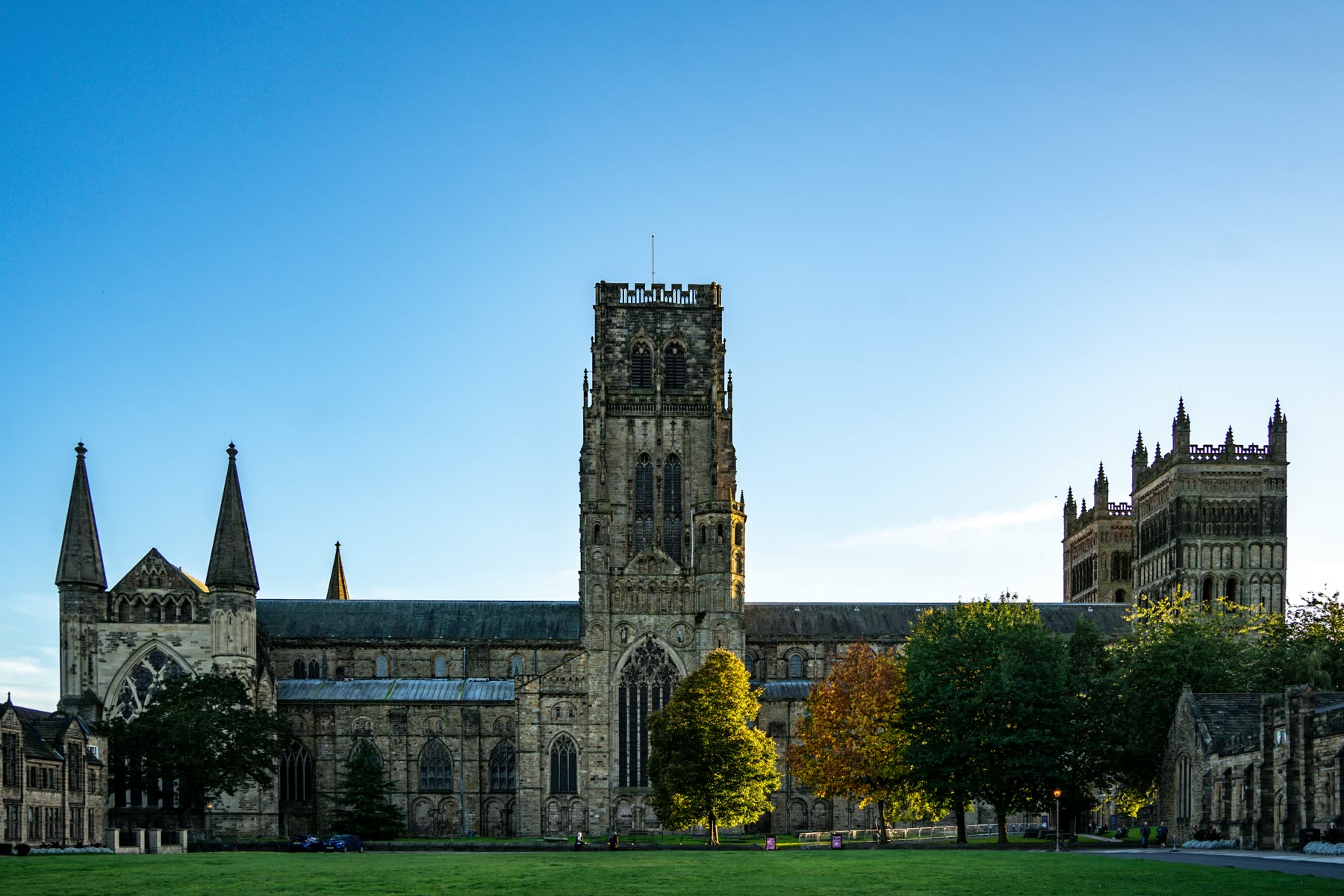
On the cover: Durham Cathedral and Palace Green, at the heart of Durham University, which issues the CAS up to five months before a course starts. Photo: Jeffrey Zhang / Unsplash.
The Bottom Line
The visa is the last step, not the first. You can only apply once your university has sent you a Confirmation of Acceptance for Studies (CAS), and it only does that once your offer is unconditional and accepted. For a student whose offer depends on A-level results, that is mid-August, for a course that starts in September.
The Home Office sets the rules. They are clear, and most of them are about money: a fee, a health surcharge, and proof that you can pay your first year's fees and living costs. For the 10,306 courses in our catalogue with a fee the university priced for that course, the money to show at the visa stage ranges from about £29,000 to £40,000 for the middle half. Not every applicant has to submit the evidence, but every applicant must have the money.
What you absolutely need to know:
- The CAS comes first, and it comes from the university
- You must hold the money for 28 days in a row, and the figure rises on 30 November 2026
- Some nationalities do not have to submit the evidence — but still need the money
- You pay a visa fee and a health surcharge when you apply
- The English level for the visa is B2, and your university may test it itself
- A TB test or an ATAS certificate may be needed, depending on your country and course
- The visa lets you work part-time, and the Graduate visa after it is now 18 months
| Date | What happens |
|---|---|
| 20 March 2027 | Earliest visa application from outside the UK (6 months before) |
| 12 August 2027 | A-level results day: a conditional offer can become unconditional |
| 20 August 2027 | Earliest arrival (1 month before the course) |
| 2 September 2027 | Three weeks after results: the usual decision time |
| 20 September 2027 | Course starts |
Example: a course starting on 20 September 2027. The 2 September date assumes the CAS is issued and the visa applied for on results day; in practice universities take from two to seven working days to issue a CAS.
Source: Home Office, Student visa guidance, read 7 October 2026; AQA, results days, read 7 October 2026.
1. The CAS comes first, and it comes from the university
A CAS is a reference number. Your university sends it once you have a place, and you enter it on the visa application. You must apply for the visa within six months of receiving it.
The university decides when. Every university we read for our guide to what happens after an offer, where it states its conditions, issues the CAS only once the offer is unconditional and accepted. Some also wait for a deposit, a passport copy or a confirmation of your details. Several will not issue one more than six months before the course starts. Durham issues it up to five months before; Manchester says to expect it three to four months before.
Allow days, not hours. Durham says a CAS usually follows two to three working days after you confirm your details. Cardiff asks you to allow at least five working days, and Edinburgh says a draft follows within five to seven. In August, all of them warn that it can take longer.
2. You must hold the money for 28 days in a row
The Home Office requires you to show that you can pay your course fees for one academic year, as stated on your CAS, plus living costs for up to nine months.
The money must be held for at least 28 days in a row. The last day of those 28 days must be within 31 days of the date you apply. A balance that arrives the week before you apply does not count.
It can be in a parent's account. The parent must provide a letter agreeing that you can use it, and universities' visa guidance also asks for proof of the relationship, such as a birth certificate. A student loan or an official financial sponsor counts too, with a letter from the lender or sponsor.
The living-cost figure rises on 30 November 2026. Every student starting in September 2027 will apply after that date.
| Course location | Per month | For 9 months |
|---|---|---|
| London | £1,570 | £14,130 |
| Outside London | £1,203 | £10,827 |
For applications made on or after 30 November 2026. London means the City of London and the 32 London boroughs. A course shorter than nine months uses the number of months of the course, with any part month rounded up.
Source: Home Office, Statement of changes to the Immigration Rules HC 584, laid 3 September 2026; Appendix Student, read 11 September 2026.
Added to the first-year fee, it is a large sum. We added the living-cost figure to the published first-year fee for every course in our catalogue where the university priced that course itself.
| First-year fee | Fee plus living costs | |
|---|---|---|
| Lower quarter | £18,200 | £29,077 |
| Median | £21,795 | £33,402 |
| Upper quarter | £28,500 | £39,987 |
Each figure is computed per course, and the quarter taken afterwards, so the columns do not add across. Living costs at the 30 November 2026 rates, by whether the university is in London. A deposit already paid may reduce what you must show; ask your university how it appears on your CAS.
Source: Telariq analysis of 10,306 courses at 88 universities, read 7 October 2026; Home Office, HC 584.
3. Some nationalities do not have to submit the evidence
The Home Office keeps a list of nationalities who do not have to send financial evidence with the application. It includes, among others, Canada, China, Hong Kong, Japan, Malaysia, Singapore, the United Arab Emirates, Qatar and the United States. India, Pakistan, Nigeria and Saudi Arabia are not on it.
Being on the list does not remove the requirement. You must still have the money. GOV.UK says that you might be asked for the evidence before a decision is made, so it should be ready either way.
| Country | Financial evidence submitted with the application | TB test | ATAS for a sensitive subject |
|---|---|---|---|
| Canada | Not by default | No | Exempt |
| China | Not by default | Yes | May be needed |
| Hong Kong | Not by default | Yes | May be needed |
| India | Yes | Yes | May be needed |
| Japan | Not by default | No | Exempt |
| Malaysia | Not by default | Yes | May be needed |
| Nigeria | Yes | Yes | May be needed |
| Pakistan | Yes | Yes | May be needed |
| Qatar | Not by default | No | May be needed |
| Saudi Arabia | Yes | No | May be needed |
| Singapore | Not by default | No | Exempt |
| United Arab Emirates | Not by default | No | May be needed |
| United States | Not by default | No | Exempt |
"Not by default" means the evidence may still be requested. The TB test applies if you have lived in a listed country for six months or more and were living there within the last six months. ATAS applies only to certain subjects, set by the course's subject code.
Source: Home Office, Student visa: money you need; Tuberculosis tests for visa applicants; Find out if you need an ATAS certificate — all read 7 October 2026.
4. You pay a visa fee and a health surcharge when you apply
The visa fee is £558, from outside the UK, since 8 April 2026.
The immigration health surcharge is £776 for each year of the visa for students. It is paid when you apply, and it is charged on the length of the visa, not the course.
The visa is longer than the course. For a course of 12 months or more, the visa runs from up to one month before the course starts to four months after it ends. Home Office guidance for its staff says the surcharge is then charged in six-month periods, with any part period rounded up.
Neither is the whole cost. The fee for an English test, a TB test and travel come on top, and their prices are set by the providers, not the Home Office.
5. The English level for the visa is B2, and your university may test it itself
For a degree, the Home Office requires English at level B2 on the Common European Framework of Reference. You can show it with a Secure English Language Test, certain UK qualifications, or a degree taught in English.
Your university may assess it itself. A university teaching at degree level can assess your English itself, to the same B2 standard. It may ask for a different test from the one you planned. Citizens of a listed group of countries, including Australia, Canada, Ireland, New Zealand and the United States, do not have to prove their English for the visa.
The university's own requirement is separate, and usually higher. Meeting B2 for the visa does not mean meeting the English condition in your offer.
6. A TB test or an ATAS certificate may be needed
A tuberculosis test is needed if you are coming for six months or more and have lived in a listed country for six months or more, and were living there within the last six months. GOV.UK lists 72 countries and territories with approved clinics, including Bangladesh, China, Hong Kong, India, Malaysia, Nigeria and Pakistan, and a further group whose residents must take the test in another country. The test is a chest x-ray at a Home Office approved clinic, and the certificate is valid for six months.
An ATAS certificate is needed for some subjects, for students who are not nationals of an exempt country. It is mainly for master's and doctoral study, but GOV.UK notes that an integrated master's year can bring an undergraduate course into scope. Our catalogue holds 1,843 MEng, MSci, MPhys and MChem courses. Whether one needs ATAS depends on its subject code, which the university can give you from your offer.
ATAS takes at least 30 working days, longer between April and August, and the certificate must be in hand before you apply for the visa. It costs nothing to apply for.
7. The visa lets you work part-time, and the Graduate visa after it is now 18 months
During term, a degree student may work up to 20 hours a week, provided the university is a higher education provider with a track record of compliance. Full-time work is allowed in vacations, including before the course starts. A Student visa holder cannot be self-employed.
Most undergraduates cannot bring dependants. Only government-sponsored students and students on postgraduate research courses can bring a partner or children.
The Graduate visa lets you stay and work after the degree, without a sponsor. It is 18 months for applications made on or after 1 January 2027. A student starting in 2027 would apply after that date. It costs £937, plus the health surcharge at the full rate of £1,035 a year, and it cannot be extended.
What people get wrong
"Living costs are £1,171 a month outside London." That is the figure on GOV.UK's Student visa pages as we read them. From 30 November 2026 it is £1,203, and £1,570 in London rather than £1,529. Anyone starting in September 2027 applies after the change.
"The Graduate visa is two years." It was, and most pages still say so. From 1 January 2027 it is 18 months.
"My country is on the list, so I do not need the money." You do not need to submit the evidence. You still need the money, and you can be asked for it.
Our advice
Plan for a CAS in August if your offer depends on results, and have everything else ready before then: the money held for 28 days, the English result, the TB certificate and any ATAS certificate.
Start the 28 days early. Money moved into an account late in July may not have been there for 28 days by results day.
Check whether your course needs ATAS as soon as you hold the offer. Thirty working days does not fit between results day and a September start.
Ask your university how any deposit you have paid will appear on your CAS. It changes the sum you must show.
Check every figure against GOV.UK before you apply — the Home Office changes them, and the next change is on 30 November 2026.
The not so fine print: what was excluded in this report
- Applications made from inside the UK, which have their own fee and timing
- Students under 18, who need their parents' consent and face extra conditions
- Dependants, who can only come with government-sponsored students or postgraduate research students
- Credibility interviews, which some universities hold before issuing a CAS and which our guides for individual countries cover
- The price of English tests, TB tests and priority services, which are set by the providers
- Visa refusal and appeal
Have a question? We'd love to hear from you — admin@telariq.com