
Noor's choice: the scholarship or the bond?
One student in Doha, five UK engineering courses — and three very different ways to pay for them.
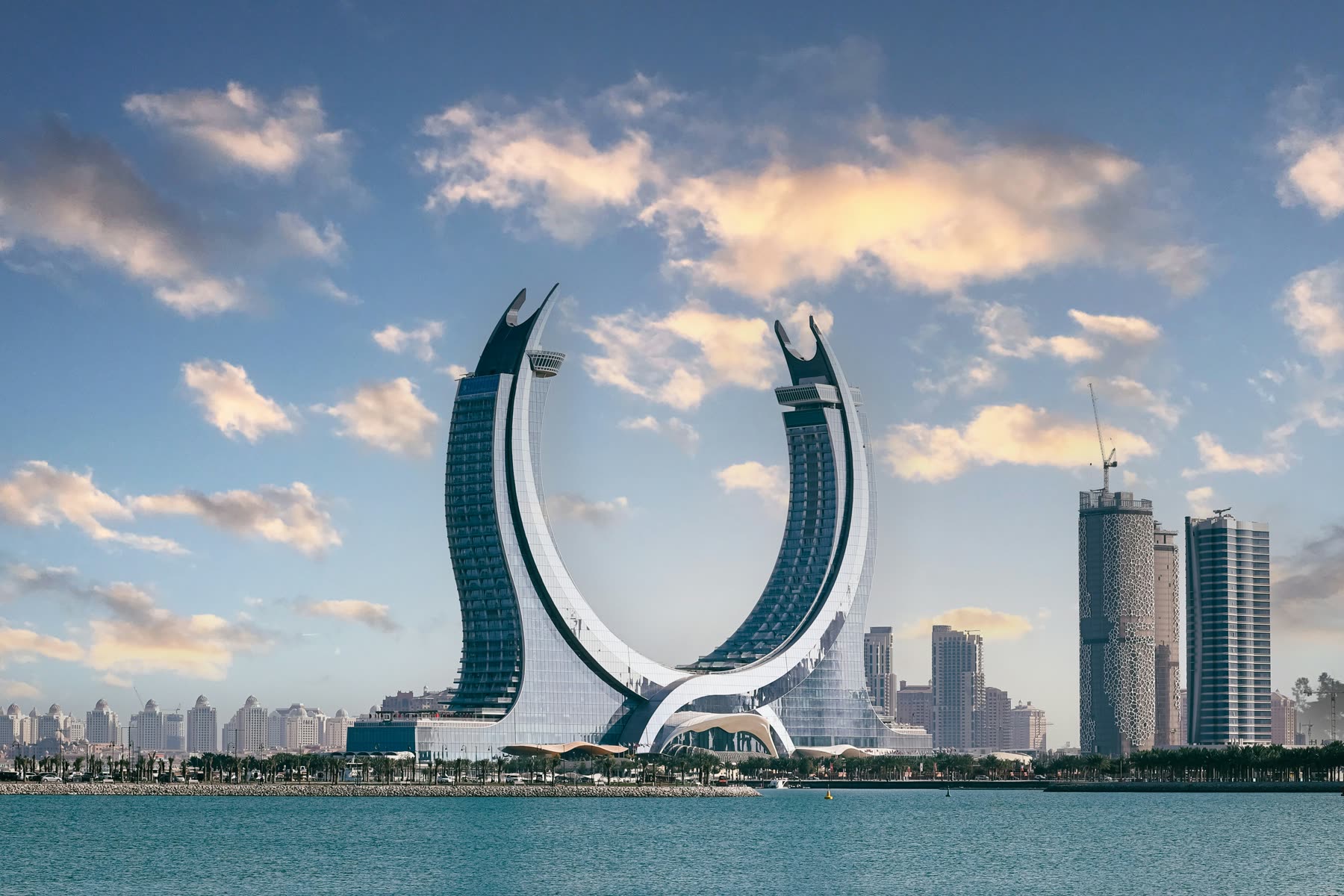
On the cover: the Katara Towers, Lusail. In Qatar, every route to a UK degree we found comes from the government or an employer. Photo: Popup Agency / Unsplash.
The Bottom Line
For a Qatari student with strong grades, the question is rarely whether a UK degree can be paid for. It is which way to pay — and what each way asks in return.
We followed one student's decision using real figures for real universities and real funding routes, all read on the providers' own pages. Noor is illustrative. The courses, fees and schemes are real.
What she found is that the money is there, from three directions: her government, Qatar's largest employers, and her family. The differences lie in what comes after the degree — and in timing, because one of the three can't be applied for until she holds an unconditional offer.
The applicant
Noor, 17, Doha
| Studying | A-levels at an international school — predicted A*AA in Mathematics, Further Mathematics and Physics |
| Wants | Mechanical engineering, starting September 2027 |
| Citizenship | Qatari |
| Deciding between | A government scholarship, an employer scholarship with a bond, or her family paying |
Step 1. What her five choices cost
Noor chose five UK universities strong in engineering: Imperial, UCL, Manchester, Bristol and Nottingham. On the annual fee they look broadly similar. Across the whole degree, they are not.
| University | Course | Annual fee | Years | Tuition, whole course | Living costs | Total |
|---|---|---|---|---|---|---|
| University of Bristol | Mechanical Engineering | £31,300 | 3 | £93,900 | £32,481 | £126,381 |
| University of Nottingham | Mechanical Engineering | £33,000 | 3 | £99,000 | £32,481 | £131,481 |
| The University of Manchester | Mechanical Engineering | £35,700 | 3 | £107,100 | £32,481 | £139,581 |
| UCL | Mechanical Engineering | £44,400 | 3 | £133,200 | £42,390 | £175,590 |
| Imperial College London | Mechanical Engineering (MEng) | £45,500 | 4 | £182,000 | £56,520 | £238,520 |
International fees as each university publishes them, for the latest year listed. Living costs at the Home Office requirement — £14,130 a year in London, £10,827 elsewhere. Source: Telariq data.
Imperial's mechanical engineering degree runs four years — it publishes no three-year version — and sits in London, so the whole degree comes to £238,520, almost twice Bristol's £126,381.
What changed: the gap between her choices is over £100,000. Which route pays for the degree matters as much as which university she picks.
Step 2. Which of them her government will fund
Qatar's Ministry of Education and Higher Education funds Qatari students to study abroad after high school, at universities on its approved list. Its most prestigious award, the Emiri Scholarship, is for students admitted to the world's most selective universities, including Oxford.
The approved list is what decides it. The University of Manchester, for example, confirms that it is approved on the ministry's Study Abroad track for bachelor's degrees, including those with an integrated foundation year.
What changed: before comparing anything else, Noor needs to check that each of her five — and her course at each — is on the ministry's list.
Step 3. Three ways to pay
| Route | Who offers it | What it asks afterwards |
|---|---|---|
| Government scholarship | Qatar's Ministry of Education and Higher Education — the Study Abroad track, or the Emiri Scholarship for the most selective universities | Not recorded in our research — ask the ministry |
| Employer scholarship | Qatar Airways | At least five years with the airline, in the department and location it assigns |
| Employer scholarship | QatarEnergy | Employment, depending on the company within QatarEnergy each scholar is assigned to |
| Employer scholarship | QAPCO | Scholars join the company as staff after graduating |
| Family pays | — | Between £126,381 and £238,520, depending on the university |
Each provider's own pages. Source: Telariq data.
All three scholarship routes are for Qatari students — Qatar Airways' is also open to students whose mother is Qatari. We found no bank in Qatar that offers an education loan for a UK degree, so the realistic choice is between these.
What changed: Noor isn't choosing whether she can afford a UK degree. She's choosing who she'll owe, and what.
Step 4. What each asks in return
The employer scholarships come with a job. Qatar Airways is the most specific: at least five years, with the airline choosing her department and location. QatarEnergy and QAPCO bring scholars into the company on graduating, with the details set by their own rules.
For a mechanical engineer, that isn't necessarily a cost. Qatar's energy and petrochemical companies employ engineers, and a sponsorship can turn into the first job she would have wanted anyway. The question is whether she wants that decision made now, at 17.
The government scholarship's terms after graduation weren't recorded in our research, so Noor will ask the ministry directly before deciding.
What changed: if Noor wants to keep her options open after graduating, the government scholarship may suit her better — once she knows its terms. If she already wants a career in energy, QatarEnergy or QAPCO could be the stronger choice.
Step 5. UK universities offer Qatari students very little of their own
Only one UK university scholarship in our records is restricted to Qatari students — Edinburgh Napier's £2,000 for the first year — and none at Noor's five. By contrast, we found 17 awards restricted to Indian students and 19 open to American students.
What changed: Noor's money will come from Qatar, not from the universities. Her shortlist can be chosen on the course, not on which university offers a discount.
Step 6. Timing: one route waits for an unconditional offer
Her five UCAS choices go in by 13 January 2027. The employer scholarships run their own selection, so she'll check each sponsor's window early.
The government scholarship is applied for once she holds an unconditional offer. The University of Manchester's guidance for Qatari students describes it in exactly those terms, and gave the ministry's application window for 2024 as mid-June to mid-August — after A-level results, when offers become unconditional.
What changed: Noor can apply for an employer scholarship and keep the government route open at the same time. She doesn't have to choose until both answers are in.
Noor's plan
| Step | What she does |
|---|---|
| UCAS, by 13 January 2027 | Imperial, UCL, Manchester, Bristol and Nottingham — once she has confirmed each is on the ministry's approved list |
| Employer scholarships | QatarEnergy and QAPCO, which fit her subject; Qatar Airways only if she wants a career in aviation |
| Government scholarship | Applies once she holds an unconditional offer, and asks the ministry what it requires after graduation |
| The decision | Made in the summer, with every offer and every condition in front of her |
None of this says which route is better. A five-year bond is a good deal for a student who wants that career, and a poor one for a student who doesn't. What the numbers show is that a Qatari student with strong grades has real routes to fund a UK degree — and that the real choice is about the years after it.
Do this for your own decision
1. Cost the whole degree. Course length and city change the total by more than the annual fee suggests.
2. Check the approved list. A government scholarship only follows you to a university and course it approves.
3. Read what each route asks afterwards. Years of service, who chooses your role, and where.
4. Mind the timing. Some scholarships need an unconditional offer first; others run their own selection windows.
5. Keep routes open in parallel until you have every answer.
Our advice
Apply to more than one route at once. The government scholarship and the employer scholarships run on different timetables, and you don't have to choose until both have answered.
Confirm every scholarship's terms and windows with the provider — and every university's fees — before you rely on them.
The not so fine print
- Noor is an illustrative applicant. Every figure about a university or a scholarship is real
- Fees are each university's published international fee for the latest year it lists; later years may rise
- Living costs are the Home Office requirement, a legal minimum rather than a household budget
- The ministry's approved list and its terms after graduation change from year to year; check them directly
- This is a worked example, not advice about which route or university to choose
A note on this guide. This is what we found when we read each provider's own pages. Its purpose is to show you that options exist and where to start looking. There will be routes we haven't found yet, and some here may have changed since we checked — so treat it as a starting point, not a complete list, and confirm everything with the provider before you rely on it.
Have a question? We'd love to hear from you — admin@telariq.com