
The shortlist that looked right
One student. Five universities. Six questions that changed the list.
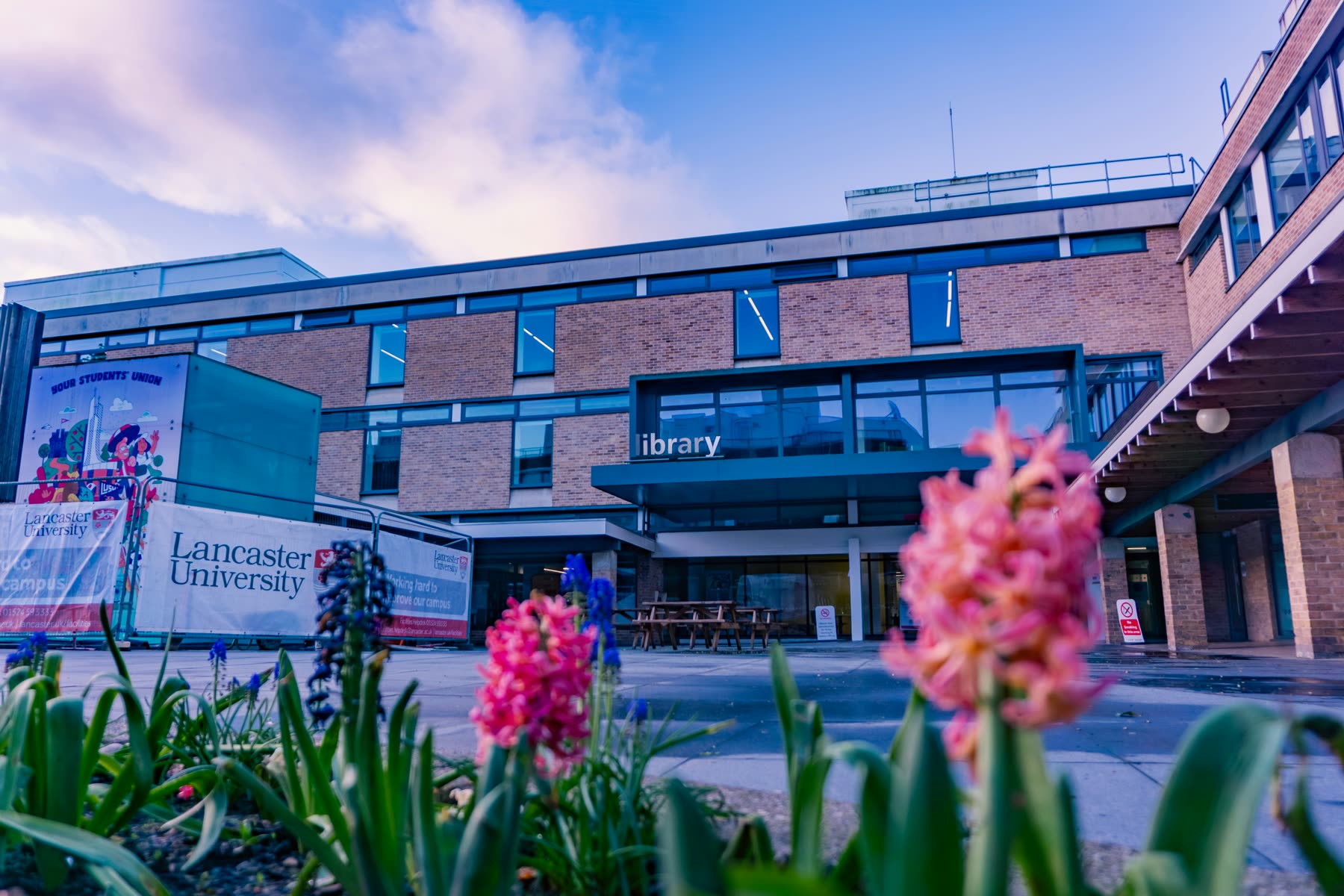
On the cover: the library at Lancaster University — one of the two universities that fit Priya's shortlist, and the one that publishes nothing about Indian qualifications. Photo: Focus Pictures / Unsplash.
The Bottom Line
Every guide we have published answers one question across every university. A family has the opposite problem: one child, one subject, a handful of universities, and every one of those questions at once.
So here is what that looks like in practice. We followed one applicant through the whole decision, using real figures for real universities, and watched her shortlist change at every step. She is illustrative. Every number about the universities is real, taken from Telariq's records.
She starts with five universities chosen the way most families choose — by name. By the end, two fit, one nearly fits, one is a stretch, and one she would be spending a UCAS choice on with very little to show for it.
The applicant
Priya, 17, Mumbai
| Studying | CBSE Class XII — predicted around 92% overall |
| Wants | Computer Science, starting September 2027 |
| Family budget | About £130,000 for the whole degree, including living costs |
| Starting shortlist | UCL · King's College London · Loughborough · Lancaster · Heriot-Watt |
Step 1. What does it really cost?
Priya's family started where most families start — with the annual fee. On that basis Heriot-Watt, at £26,840 a year, looked the most affordable and UCL, at £48,600, the least.
But Heriot-Watt is in Scotland, where Computer Science runs four years, not three. And every student also has to show the Home Office they can cover their living costs: £1,570 a month in London, £1,203 elsewhere, for nine months of each year.
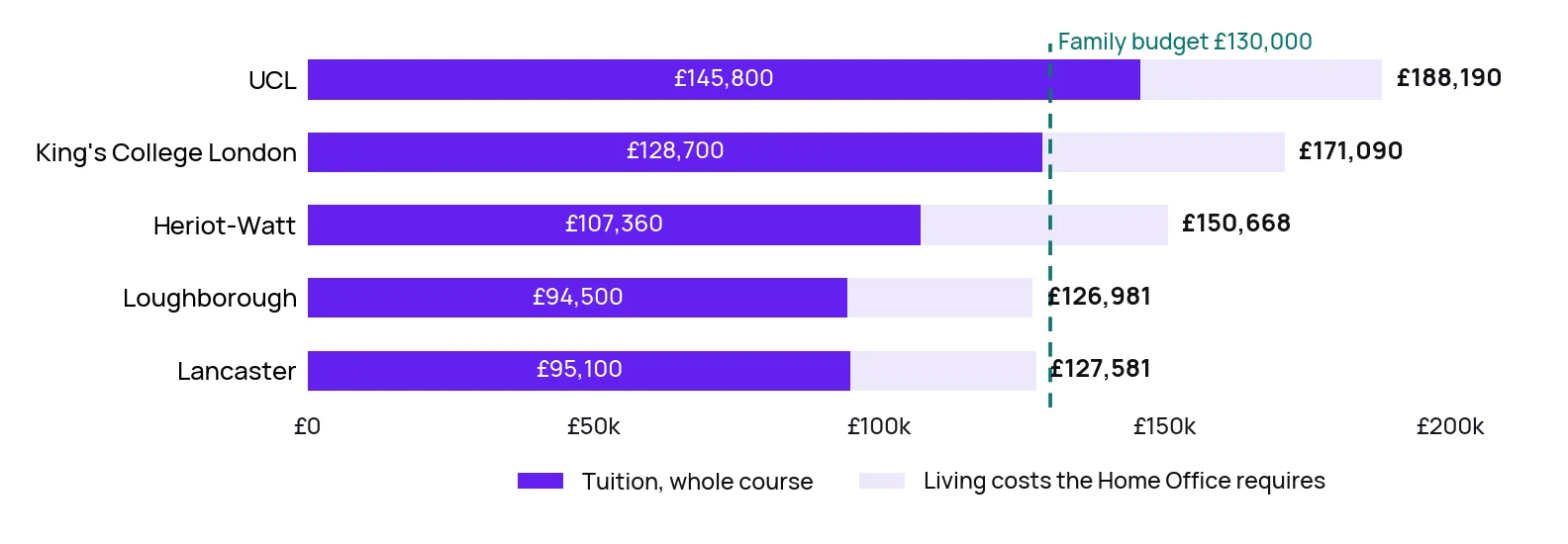
Computer Science BSc at each university, 2027/28 international fees as published, applied across the published course length. Living costs at the Home Office requirement from 30 November 2026. Source: Telariq data.
What changed: Heriot-Watt, the cheapest per year, is the third most expensive overall at £150,668. UCL and King's are £58,190 and £41,090 over the family's budget. Only Loughborough, at £126,981, and Lancaster, at £127,581, fit.
Step 2. Will they accept her qualification?
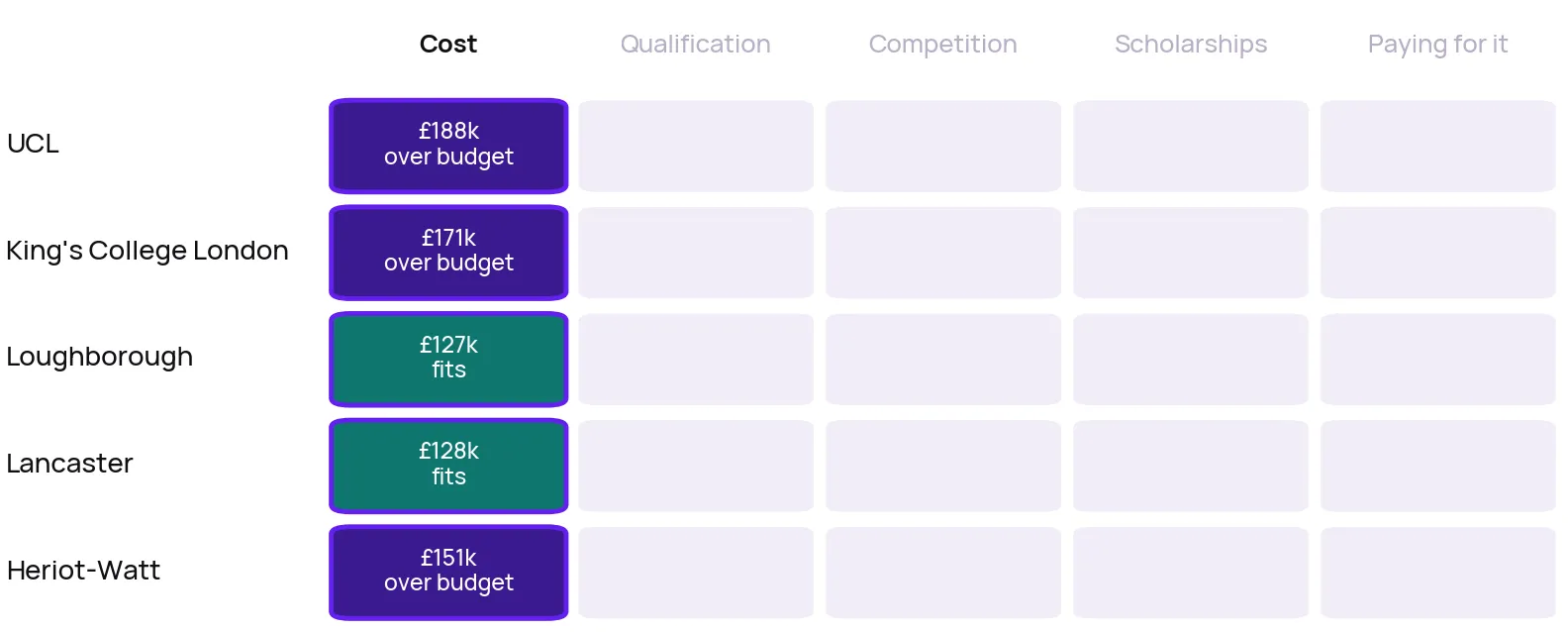
Each university publishes how it treats an Indian Class XII — or doesn't. For the same applicant with the same grades, the answers could hardly be more different.
UCL asks for five CBSE subjects at 95, 95, 95, 95 and 90. Priya is predicted around 92%. On the published requirement, she falls short.
King's College London accepts only the CBSE and CISCE boards — a student on a state board would be out before applying. Its page gives no grade equivalent for India, so Priya would have to ask.
Loughborough typically asks for 78% to 88% averaged across her strongest four subjects. She clears it.
Heriot-Watt asks for 65% overall for computing — lower than the 70% it asks for most other subjects. She clears it comfortably.
Lancaster publishes nothing at all about Indian qualifications on its international entry requirements page.
What changed: UCL drops out unless her predicted grades rise. Two universities need an email before she can know where she stands.
Step 3. How competitive is it for her?
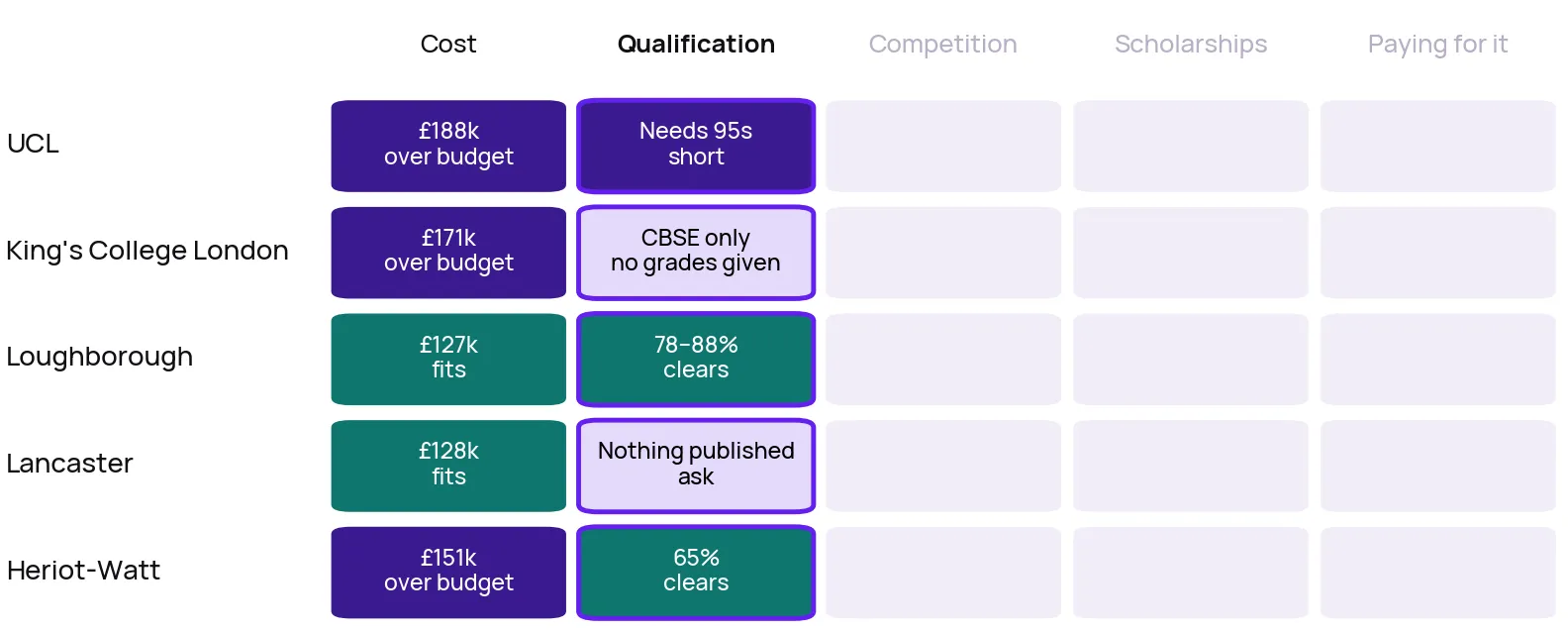
UCAS publishes how many applications each university receives and how many offers it makes. For computing in 2025, the share of applications from women that received an offer ranged from one in five to nearly nine in ten.
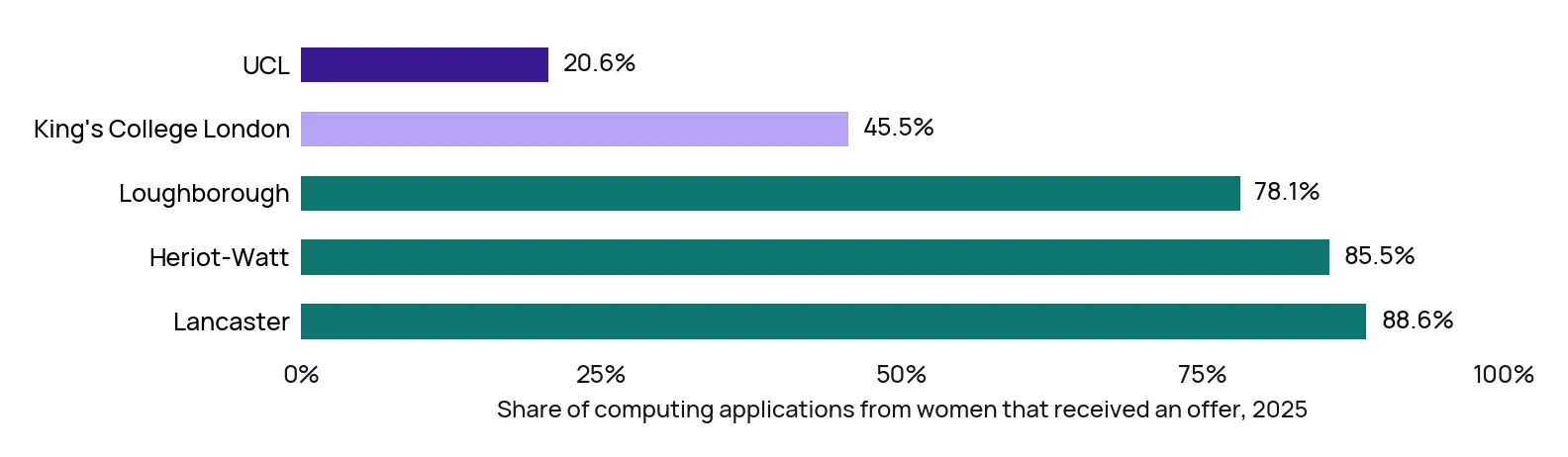
Offers as a share of applications from women, computing, 2025. Women's offer rate was slightly higher than men's at all five. Figures cover all applicants, UK and international. Source: Telariq data, from UCAS.
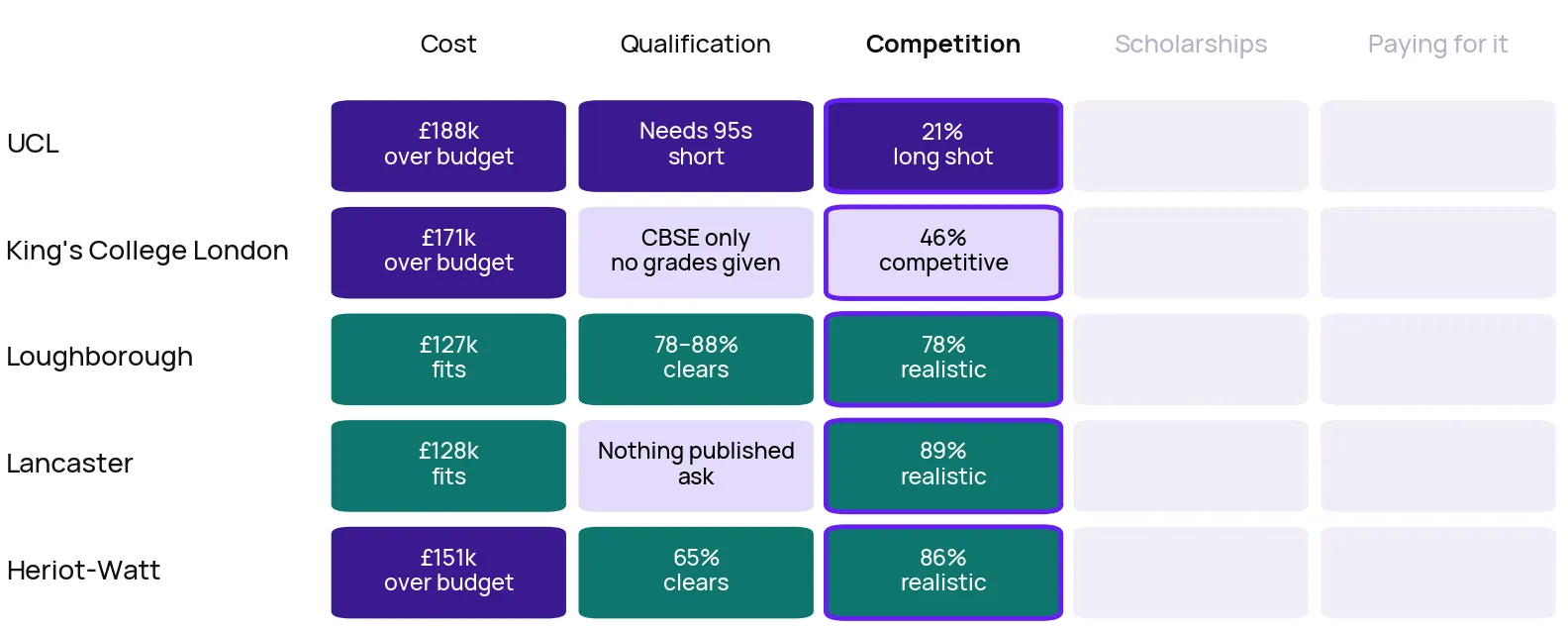
What changed: UCL and King's are genuine stretches; the other three are realistic. That on its own would be a sensible balance for a UCAS application — but only if the stretches were affordable and within her grades.
Step 4. Which scholarships are actually open to her?
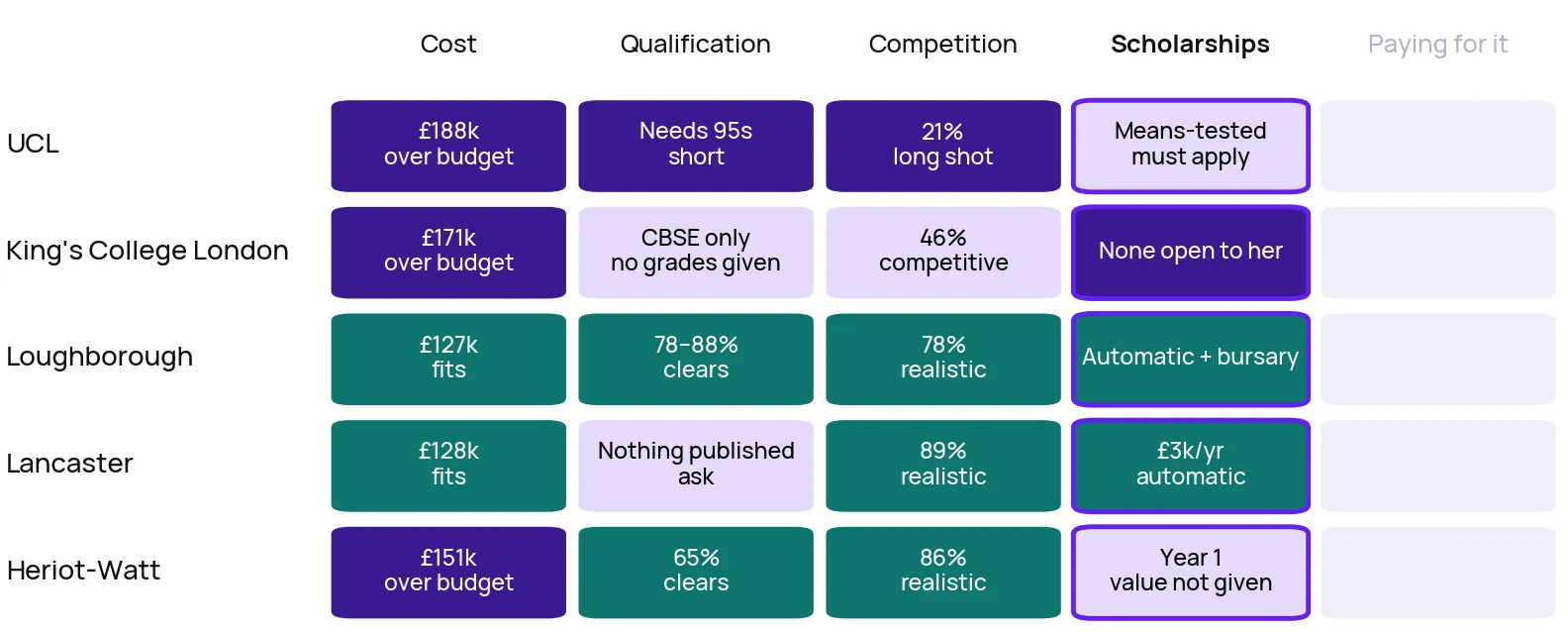
The headline awards are not the ones she can use. The scholarships Priya can actually apply for look very different from the ones each university advertises most prominently.
UCL has the largest single award in our records, £53,000 a year — restricted to students from Saudi Arabia, Jordan, Palestine, Ecuador and Syria. What is open to her is the UCL Global Undergraduate Scholarship, which is means-tested and has to be applied for. UCL also lists a £5,000 International Excellence scholarship, but it belongs to its Global Business School for Health, not to computer science.
King's College London has two undergraduate awards in our records, for students from Hong Kong and Greece. There is nothing she is eligible for.
Loughborough gives an automatic International Scholarship of 25% of the first-year fee — £7,875 on this course — and an automatic £3,000 a year International Excellence award. Separately, a Women in Science bursary of £1,000 a year is open to her to apply for. The university doesn't state whether these combine.
Lancaster gives an automatic India Scholarship of £3,000 a year — £9,000 across the degree, taking her total to about £118,600.
Heriot-Watt offers an International Merit Scholarship for the first year only. It does not publish the value.
What changed: the two most expensive universities have the least for her. The two that already fit her budget are the two that give her money without her having to ask.
Step 5. How should she use her five UCAS choices?
All five universities share the same deadline — 13 January 2027 — because none of them is Oxford, Cambridge, or a medicine course. All five are Computer Science, so one personal statement works for all of them.
The problem is not the paperwork. It is that two of her five choices are now doing very little. UCL falls short on published grades and sits £58,190 over budget, with one offer for every five applications. King's is over budget with no scholarship open to her. A choice spent on a university she cannot realistically take up is a choice not spent on one she could.
What changed: Priya has two UCAS choices to spend on universities that fit.
Step 6. How will the family pay?
This is the one question that has the same answer for all five universities, because it depends on where the family lives rather than where Priya studies.
We checked eight Indian government schemes. None funds a UK degree directly, though several subsidise interest or guarantee a bank loan, which can matter once a lender is chosen. More usefully, India has 16 lenders that can fund a complete UK undergraduate degree — more than any other country we researched.
What changed: nothing on the shortlist — the route exists for all five. But had Priya's family lived in Dubai instead of Mumbai, this step would have stopped the whole plan. Across the United Arab Emirates we checked 19 lenders and found none that could, and no government scheme either.
The shortlist now
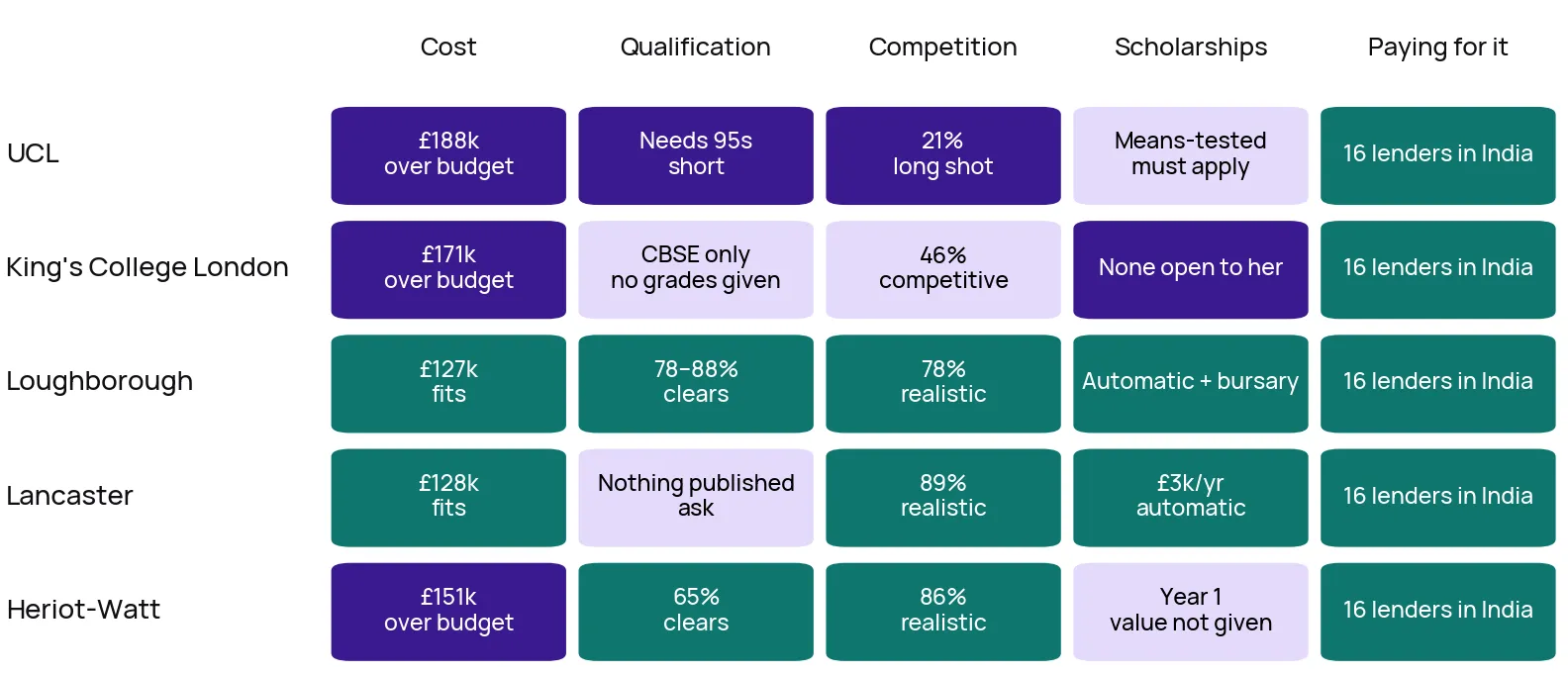
Illustrative applicant. Source: Telariq data.
| Her five UCAS choices | Where each stands after six questions |
|---|---|
| Loughborough | Fits on every count |
| Lancaster | Fits, once it confirms how it treats her qualification |
| Heriot-Watt | Fits on everything except the four-year cost — £20,668 over budget |
| King's College London | A stretch — over budget, no scholarship open to her, 46% offer rate |
| UCL | Replaced with a choice she could realistically take up — short on published grades and £58,190 over budget |
None of this says anything about which university is better. UCL is not a worse university for Priya; it is a worse use of a UCAS choice for this particular student, with these grades and this budget. A different student would get a different scorecard.
Do this for your own shortlist
1. Cost. Annual fee × the course's published length + the Home Office living-cost figure for that city. Compare the total with your budget, not the annual fee.
2. Qualification. Find the university's page for your country and your exact qualification. If there isn't one, write to admissions before you apply.
3. Competition. Check how many applications in your subject received an offer — and whether that differs for applicants of your sex.
4. Scholarships. Ignore the headline award. List only the ones open to your nationality and your course, and note which are automatic.
5. UCAS choices. Count how many of your five you could realistically take up. Replace the ones you couldn't.
6. Paying. Check whether a lender or government scheme in your country can fund a UK degree — before you commit to the list.
Our advice
Build the scorecard before you build the application. Every one of these answers is public, but they are published in six different places, in six different formats, by dozens of different organisations. Nobody puts them side by side for you.
Confirm every figure with the university before you apply.
The not so fine print
- Priya is an illustrative applicant. Every figure about a university is real
- Fees are 2027/28 international fees for Computer Science BSc as each university publishes them; fees can change for later years
- Living costs are the Home Office requirement a visa applicant must show, not a household budget
- Offer rates cover all applicants — UK and international — and describe the pattern, not whether any one person will receive an offer
- Scholarships are those in our records for undergraduate study; several 2026 rounds had closed and will reopen for 2027 entry
- This is a worked example, not advice about which university to choose
Have a question? We'd love to hear from you — admin@telariq.com